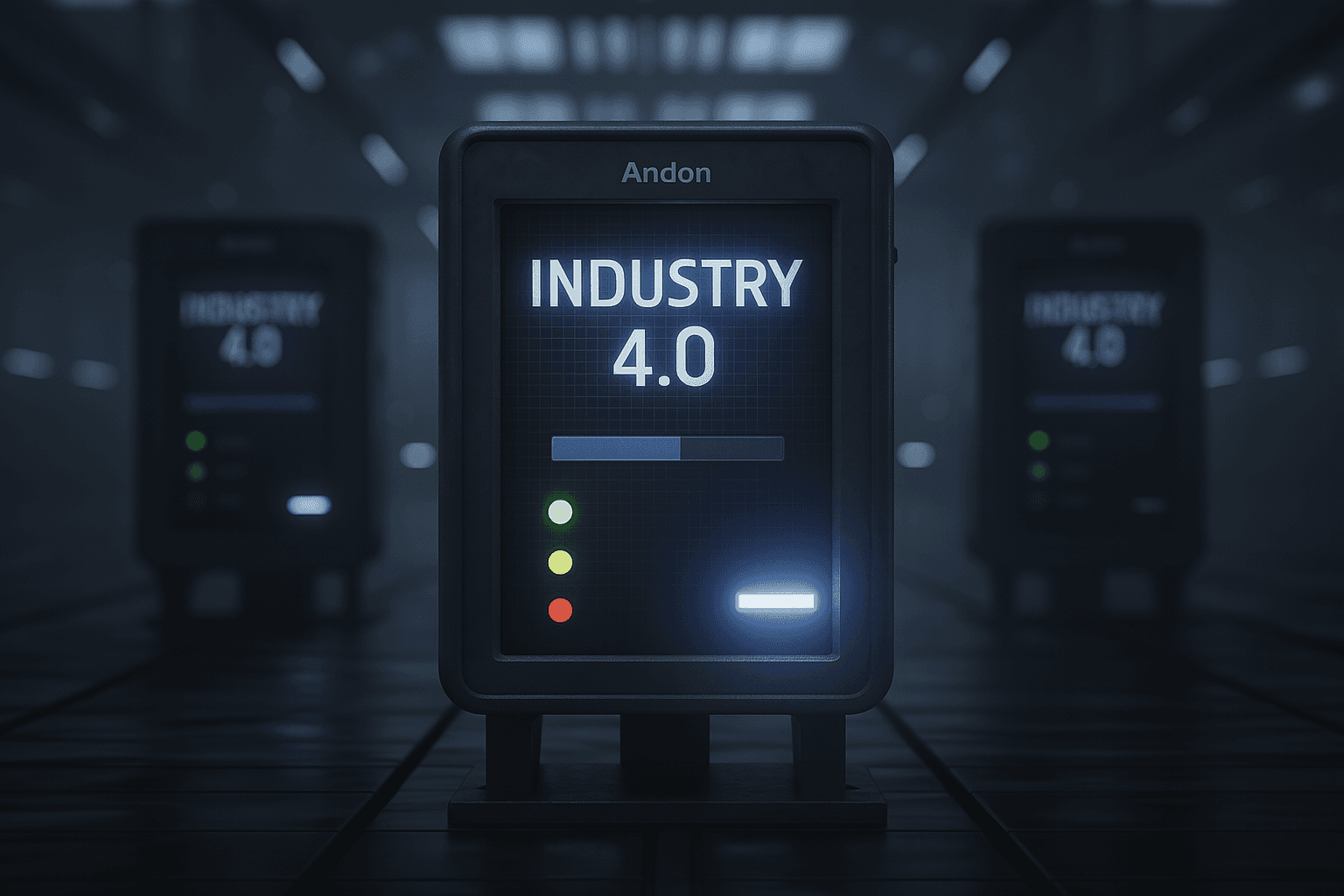
What is an Andon System and Why is it Essential for Production Optimization?
Before diving into implementation errors, let's briefly review what an Andon system is. Originating from the Toyota Production System, Andon is an industrial visual signaling system that allows operators to report problems on the production line. In its modern version, it can integrate digital technologies while maintaining its essential function: quickly identifying anomalies and triggering an appropriate response within a Lean Manufacturing approach.
You've probably already noticed that the most efficient factories all have a system to visualize their operations in real-time. This is precisely the role of an effective Andon system in the continuous improvement of industrial processes.
The Fundamental Error: Over-complicating the Andon System
The Perfectionist Engineer Syndrome
The first and most devastating error when implementing an Andon system is over-complication. As engineers or technical professionals, we are naturally drawn to adding features. "Since we're solving this problem, why not add this feature? And this one too?" This reasoning, although well-intentioned, often marks the beginning of the end for an Andon implementation project.
You may wonder how excess functionality can harm a technically sound project. The answer is simple: each additional feature exponentially increases system complexity, extends deployment timelines, and complicates adoption by end users.
Forgetting the MVP Principle in Andon Implementation
An effective Andon system should begin by answering a fundamental question: what specific problem are we trying to solve? Is it rapid detection of production stoppages? Communication of quality defects? Optimization of equipment availability?
Instead of creating a system that attempts to do everything from the start, the MVP approach involves rapidly developing a solution that addresses the most crucial need, then progressively improving it based on experience feedback.
The Solution: Prioritize Simplicity for an Effective Andon System
To go further: the Andon system in a real-world context
In this video, Martin explains simply and accessibly what an Andon system is, its origin, its use cases, and the key takeaways for a manufacturing SME.

Understanding the True Intent of the Project
The key to avoiding over-complication is to clearly define the primary objective of the Andon system. Ask yourself these questions:
- What is the fundamental problem we're trying to solve?
- What indicators will allow us to measure success?
- What features are absolutely essential to achieve this objective?
This initial clarification helps maintain focus throughout the project and avoid functional drift.
Systematically Evaluate the Value/Effort Ratio
Before adding a feature to your Andon system, systematically evaluate its value/effort ratio:
- High Value + Low Effort = Absolute Priority
- High Value + High Effort = Reassess and simplify the approach
- Low Value + Low Effort = Can be considered after essential priorities
- Low Value + High Effort = Avoid absolutely
This simple decision matrix helps maintain focus on what truly matters and avoid features that burden the system without providing proportional value.
Summary Table: Common Errors and Solutions for Andon System Implementation
| Error | Impact | Recommended Solution |
|---|---|---|
| Over-complication | Extended timelines, adoption difficulties | MVP approach, focus on essential needs |
| Exclusion of end users | System ill-suited to field realities | Involve operators from the design phase |
| Overly complex interfaces | Poor adoption, usage errors | Intuitive design adapted to industrial context |
| Lack of integration | Information silos, limited analysis | Connection with existing systems (ERP, MES) |
| Overly ambitious deployment | High risk of failure | Progressive approach, pilot projects |
| Unclear response processes | Alerts without corrective actions | Clearly define responsibilities and escalations |
Other Frequent Mistakes to Avoid in Production Line Optimization
Neglecting User Involvement in Industrial Visual Signaling
An Andon system, however sophisticated, is useless if it's not adopted by those who must use it daily. A classic mistake is designing the system in isolation, without involving production operators, supervisors, and other end users.
To avoid this pitfall, involve users from the design phase. Their feedback will help you create a system that's truly useful and adapted to their daily needs. Operators who will use the system daily can identify practical obstacles that designers might not anticipate. This early collaboration allows adjustments to the interface and features to match field realities.
Creating Overly Complex Interfaces for Anomaly Visualization
Usage complexity is a major obstacle to Andon system adoption. Too often, interfaces are designed by technicians for technicians, neglecting the reality of the operational context where the system will be used.
An effective interface for an Andon system should:
- Be intuitive and require minimal actions to report a problem
- Provide clear visual feedback on system status
- Be accessible in the production environment (visibility, resistance to industrial conditions)
- Adapt to specific workstation constraints (gloves, limited space, etc.)
Ergonomics is not a luxury but a necessity to ensure the system will actually be used in critical moments when it's most needed.
Ignoring Integration with Existing Systems in Industry 4.0
An Andon system doesn't operate in isolation. It must integrate harmoniously with other company systems: ERP, MES, CMMS, etc. Neglecting this integration often leads to information silos that limit overall effectiveness.
Simplicity doesn't mean isolation. A simple system can and should communicate effectively with the existing ecosystem. This two-way communication enriches root cause analysis and improves responsiveness to reported problems.
Practical Strategies for Successful Andon Implementation
Start Small, Think Big
Begin with a pilot project on a single line or department. This will allow you to test your approach, identify potential issues, and refine your system before wider deployment.
This progressive approach reduces risks and builds successes that will facilitate acceptance in other parts of the organization. Phased deployment also allows incorporating learnings from each stage into subsequent ones, creating a virtuous circle of continuous improvement for the system itself.
Systematically Measure the Benefits of the Andon System
A well-designed Andon system should produce measurable results: reduced downtime, improved quality, increased productivity. Establish clear indicators from the start to measure these improvements.
These measurements will not only justify the investment but also identify opportunities for continuous improvement. Analyzing trends in Andon alerts can reveal systemic problems that require deeper interventions than simply resolving incidents case by case.
Plan for the Evolution of the Industrial Signaling System
While simplicity is crucial at the start, it's also important to design the system so it can evolve. A modular architecture allows progressively adding features as needs become clearer and users master the basic functionalities.
This evolutionary approach ensures the system remains relevant in the face of changes in the production environment, available technologies, and the organization's strategic priorities. An overly rigid Andon system risks quickly becoming obsolete or unsuited to new challenges.
Establish Clear Response Processes for Production Optimization
An Andon system is only effective if it triggers concrete actions. Clearly define responsibilities and escalation processes in case of an alert:
- Who is notified first?
- What are the expected intervention timeframes?
- How are unresolved problems escalated?
- How are applied solutions documented?
These processes must be simple, documented, and known to all potential stakeholders. They constitute the "human" aspect of the Andon system, just as important as its technological component.
Frequently Asked Questions About Andon Systems
What is the typical return on investment for a well-implemented Andon system?
A properly implemented Andon system can generate significant ROI, typically between 3 and 12 months depending on the industry. The main benefits include reduced downtime (often by 20-30%), improved quality, and increased productivity through faster problem resolution. The key is to start simply and precisely measure gains to justify future investments.
How can a traditional Andon system be adapted to Industry 4.0 principles?
Evolution toward Industry 4.0 allows enriching Andon systems with features like automatic machine data collection, mobile notifications, and predictive analytics. However, it's crucial to maintain the simplicity of use and effectiveness of the original concept. A progressive approach consists of starting with a basic Andon system then gradually integrating advanced technologies based on identified real needs.
Is an Andon system suitable for small industrial operations?
Absolutely. Smaller operations may even derive proportionally greater benefit from Andon systems, as they promote rapid and efficient communication in teams where resources are limited. Implementation can be simplified and less costly, starting with basic solutions like visual boards or lightweight applications, then evolving according to needs. The key remains team involvement and clarity in alert response processes.
Conclusion
Successful implementation of an Andon system relies primarily on a fundamental principle: simplicity. Faced with the temptation to add more and more features, remember that each additional complexity decreases the project's chances of success.
By adopting a minimalist approach centered on essential needs, rigorously evaluating the value/effort ratio of each feature, and involving users throughout the process, you'll maximize your chances of success in your Lean Manufacturing initiative.
Don't forget that even projects that initially seem to have an excellent value/effort ratio can prove more complex than anticipated. This is precisely why starting with a simple solution gives you the essential margin to absorb the inevitable complications that will arise along the way.
An effective Andon system isn't one with the most features, but one that efficiently solves critical problems while being easily adopted by operational teams. Simplicity isn't just a technical virtue; it's the very key to the success of your digital transformation and production line optimization.