How De La Fontaine unlocked the equivalent of $7,125/week in capacity without buying new machines
- Useful welding time went from 115 to 210 hours per week (+82%), on the same 5 machines
- About $7,125/week in freed capacity, without spending a penny more
- 2 operators reassigned to value-added tasks
- Pilot phase completed in 4 days, on 5 welding machines
The Results
How this number is calculated: producing these 95 additional useful hours any other way (new machine and operator) would have cost about $7,125/week, that is 95 h × about $75/h in full labor and machine cost. De La Fontaine obtained them without spending a penny more.
Project Snapshot
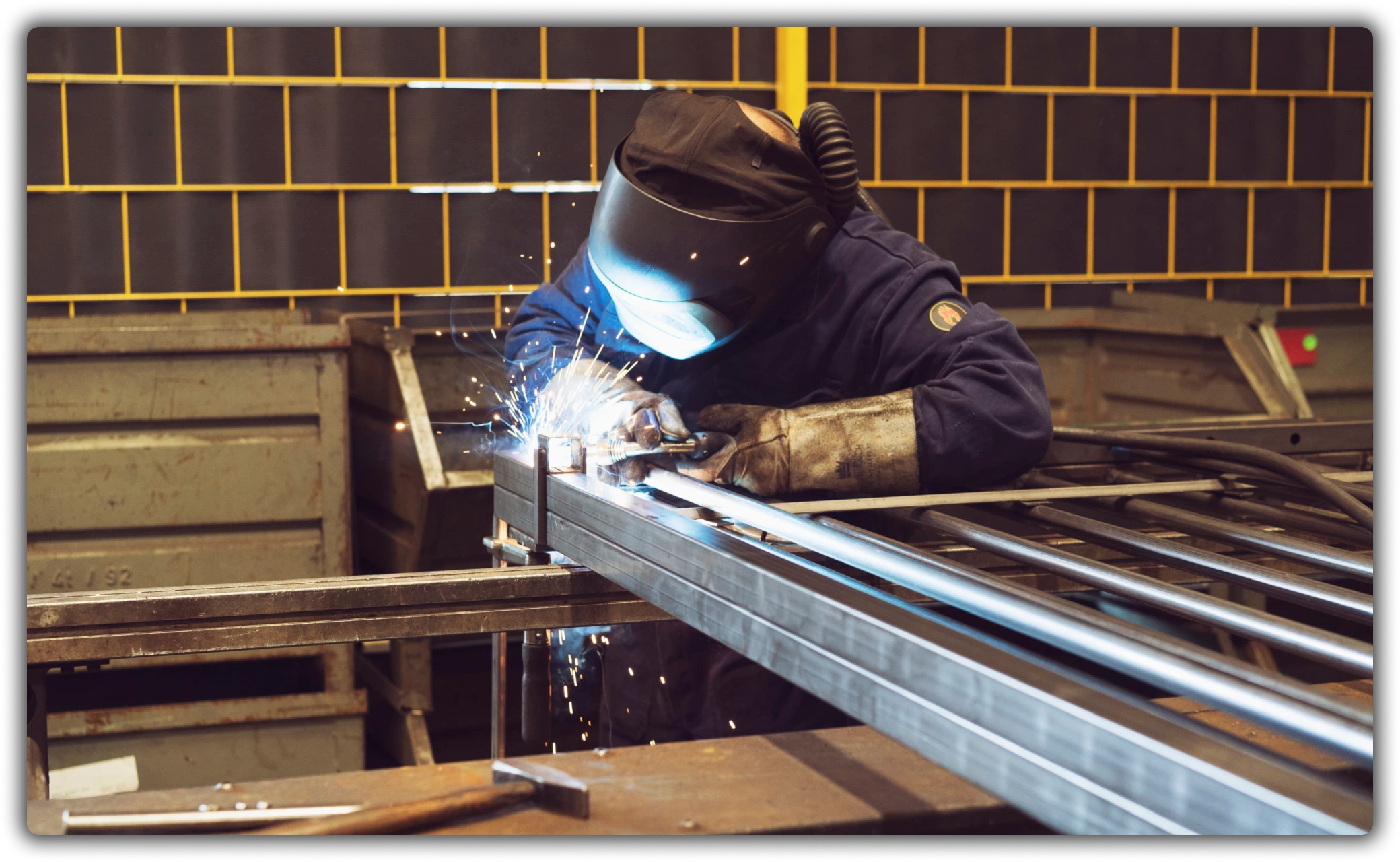
The Operational Challenge
To meet growing demand, De La Fontaine needed to increase its production capacity, without heavy investments in equipment. Referred to Intelligence Industrielle by a digital transformation coaching firm, following the success achieved at Infasco, the company first wanted to maximize the yield of its current fleet before spending, to stay competitive and meet its delivery deadlines.
The Bottleneck
Despite its leadership position, the company was hitting a major obstacle: its welding machines were only running at 20 to 25% of their useful capacity. Without precise data, it was impossible to know why, and therefore impossible to fix. Management was flying blind, and every lost hour ate into the capacity to deliver on time. A reliable production monitoring system was needed.
Improve the real performance of the welding machines, their Overall Equipment Effectiveness (OEE), by finding the true causes of slowdowns before spending on new machines.
The Deployed Solution
The OEE solution, Intelligence Industrielle's industrial performance monitoring solution, was installed on 5 welding machines. From the first days of the pilot, the team had real-time visibility into each machine's actual performance, enough to find the true causes of slowdowns and fix them before spending on new equipment.
Implementation and Adoption
Pilot phase: completed in 4 days, on 5 welding machinesIntegration was fast: the pilot phase on the 5 welding machines was completed in 4 days. Two factors accelerated adoption: De La Fontaine's team already had a solid base (several machines had been connected before), and turnkey project management with weekly meetings guided every step. With the pilot quickly proving itself, the rollout continued by machine groups.
- 1Pilot completed in 4 days on 5 welding machines
- 2Rollout by machine groups
- 3Toward 77 licenses in total
"Monitoring our machines allowed us to maintain our delivery times [...] which puts us in an extremely enviable position against the competition."
 Steve CompagnatDirector of Operations, De La Fontaine
Handling Objections
Fear of complexity on the floor
The interface and the weekly coaching enabled fast adoption by the teams, without slowing down operations.
Complex multi-site rollout
The architecture proved its ability to integrate efficiently across several sites, reassuring the client for the future rollout between the Quebec headquarters and the US plants.
Reliability of the numbers and proof of ROI
The gains were measured on real production data (pilot on 5 welding machines, then rollout), not estimated.